
Instructional designers have been held back for too long
Am I alone in feeling a hint of embarrassment when telling people I work in the eLearning industry? I understand the reason why; most people’s experience with eLearning has been a dry induction or a boring security awareness module they’re forced to complete every year.
“Oh, you help make learning like that?”
I always tell them no, we actually try to make effective learning but you can sense the skepticism. The industry is rife with bad learning and it’s all they know.
It’s not the fault of instructional designers. I’ve sat in plenty of meetings with excited IDs exclaiming at the possibilities: gamification, simulations, social learning. IDs love this stuff and aren’t short on ideas to deliver engaging and effective learning experiences.
The problem is building those experiences. As a technical engineer, I know exactly what’s involved. Anything is possible but everything comes with a cost. At the end of the day, “fast and cheap” wins over “engaging and effective” almost every time.
Two years ago I outlined the single reason xAPI adoption has struggled and pointed to the Experience API as the enabling technology for dynamic, innovative learning experiences. I singled out authoring tools as the limiting factor and after re-reading the article now, my contention remains mostly unchanged.
With one key difference: we solved the authoring tool problem. But I’ll get to that shortly.
We need to stop designing learning to meet our tools,
and start using tools that meet our learning design.
We need to stop fighting our tools
I can’t argue the root cause. L&D is a resource-constrained industry and authoring tools are necessary for creating learning quickly. It’s a shame most only output flip cards, click + reveals, and MCQ-ridden quizzes that disengage learners.
If you wanted something different like adaptive content or micro-learning, you picked a vendor who specialised in that delivery format. But then you were locked in. Experimentation and diversity of content and delivery styles was pretty much impossible, despite different learning outcomes requiring different delivery modes.
A number of AI-powered tools have entered the market claiming to revolutionise learning development but fall into the same trap. They generate the same predictable, ineffective and boring output as traditional authoring tools, only they do it much faster.
Faster was never the problem, better and effective was.We realised we needed to balance speed and cost with power. AI was the unlock we’d been waiting for, but unlike other AI tools, we didn’t want to flood the market with bad content.
We decided if we were going to do this, we’d do it in a way that made learning better.
We want Instructional Designers to dream again
We threw away all preconceived notions of how authoring tools work. Most authoring tools use a library of components to speed up content creation. Component libraries help you build predetermined interactions quickly but you’re out of luck for anything custom.
Today’s AI tools use the same component library approach with AI speeding up the assembly of components (and the result is exactly as you expect). Authoring tools are doubling down on this approach by adding more components, more templates and more features. But they’ll always be constrained by their predefined capabilities.
We wanted to do something different.
How do we let IDs create something that’s never been conceived before?
As engineers, AI coding agents completely changed how we work. We’d experienced their capabilities first-hand and wanted to bring that power to our customers. The only way to enable truly bespoke learning experiences was by creating a Design Agent that can write code.
As an instructional designer, you can ask for any interaction and the agent will build it.
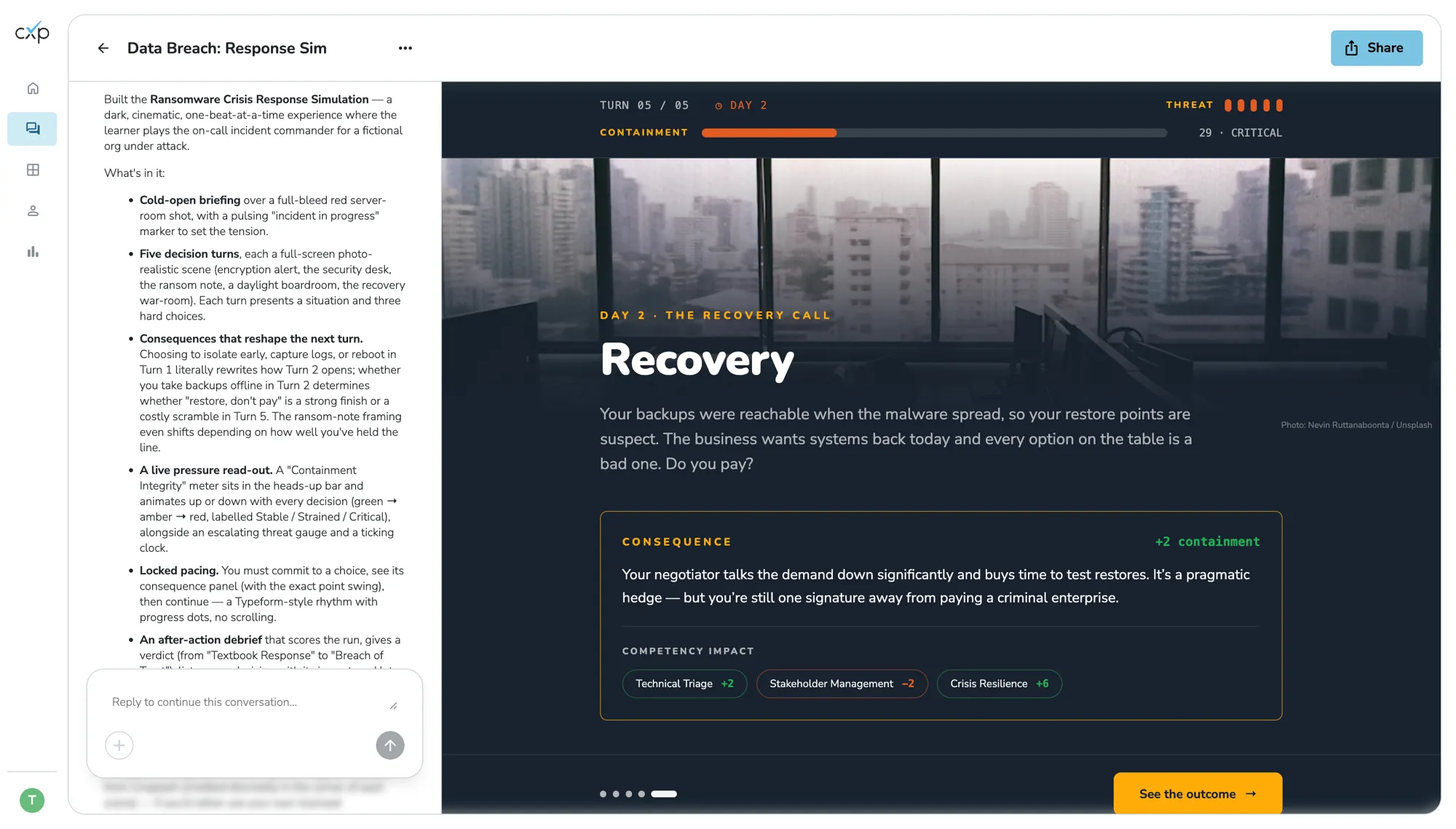
I cannot overstate how powerful this is. When you remove the constraints of a component library, the agent can build practically anything (within reason!). In showing early customers this, they’d inevitably ask:
- Can you use it to build branching scenarios?
- Does it support gamification like points and leaderboards?
- Could you create a walk-through software simulation?
- Can it add a pre-assessment to create adaptive content?
You bet it can, and it’s not because we added support for these features (we didn’t). It’s because we taught the AI to build anything and it figures it out. I’m constantly astounded by what our agent (affectionately named Clare, an intentional misspelling of Clear) can handle.
She’s not perfect and she sometimes makes mistakes but we’re yet to find a learning experience she can’t build. I’m excited to see people push the limits.
Building captivating learning experiences was only half the problem. How could we be sure this actually translated to desired outcomes?
How we ensure learning effectiveness
Cinematic visuals and dynamic pathways are flashy but don’t guarantee learners actually absorb the material (and some research indicates it could even detract from learning).
This is where our secret sauce comes in. Anything built with the Design Agent is automatically tracked with the Experience API. After building a custom learning experience, we taught Clare to apply xAPI tracking so fine-grained engagement and interaction data is always captured.
Even if your LMS doesn’t support xAPI, we bundle a tiny xAPI runtime inside the SCORM package so you can still measure effectiveness while maintaining compatibility with any standards-compliant LMS.
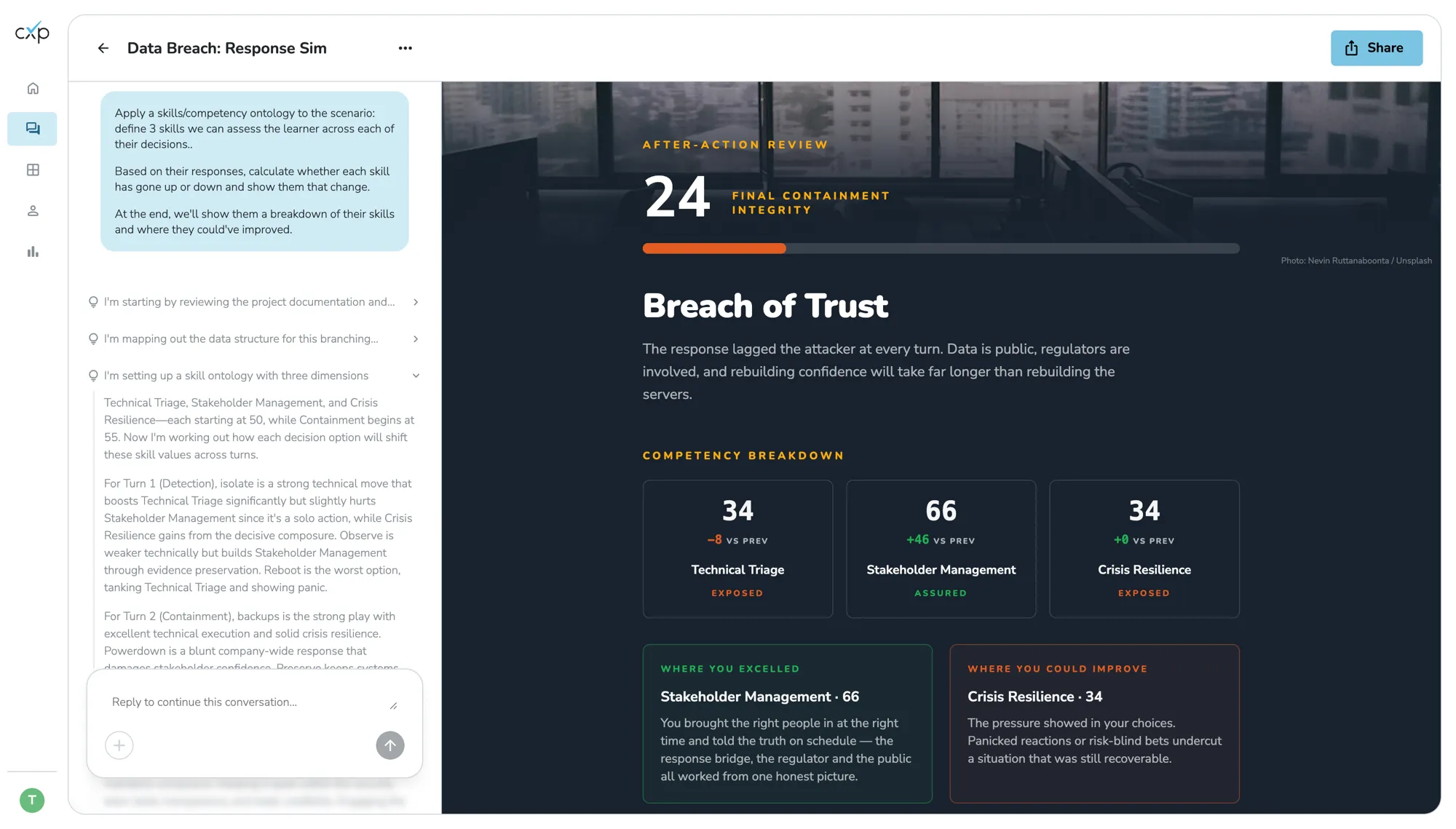
This is the real magic. When your learning experiences assess skills and capabilities, the data feeds straight through to reporting. It’s now possible to evaluate higher Kirkpatrick levels and have that feed real decision-making.
This closes the loop on learning development. If data shows learning isn’t effective, it’s now trivially easy to redevelop and experiment with a different style or delivery mode.
With AI speeding up content production, it’s imperative data shows the learning we’re creating is actually effective.
What this means for L&D teams
Does this replace the role of the ID? AI is great at suggesting surface-level concepts that sound effective but I don’t believe it cuts to the root of capability building.
The instructional designer role isn’t dead, it’s more important than ever.I believe human insight is best suited to dreaming up the most effective way to deliver learning. Our goal was to take the gruntwork away from instructional designers, freeing them to do what they do best. You no longer have to choose between fast or effective.
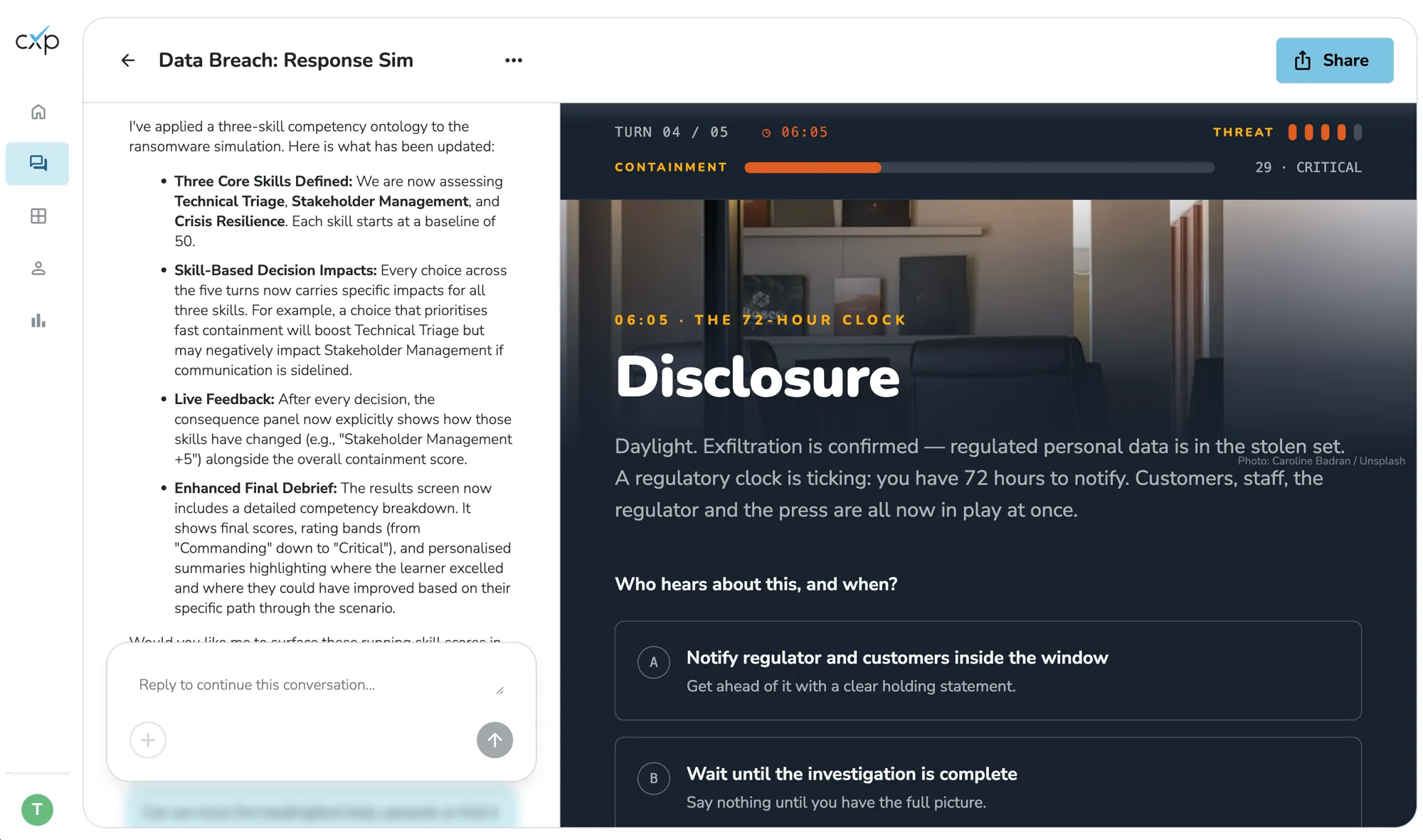
Throughout this article I provided screenshots of a Data Breach / Ransomware Crisis Simulation. This was a good example of a decision-making sim which assessed the learner’s skills and provided ongoing feedback, but it’s for illustrative purposes only. The subject matter, the delivery format, the visual style are entirely up to you.
I cannot stress enough how arbitrary all of this is – if you can describe what you want, Clare will figure out how to build it.
-
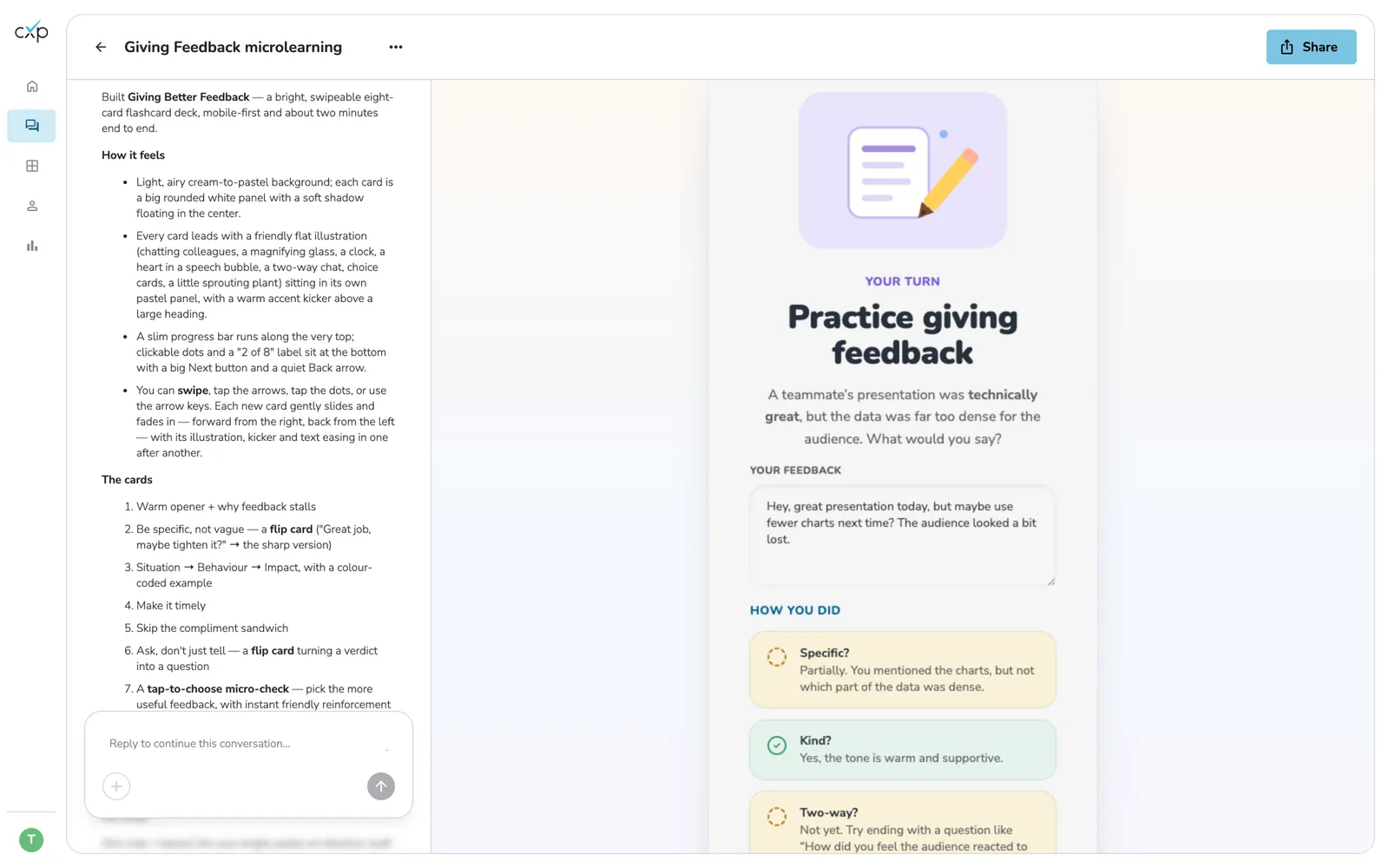
Microlearning with rubric evaluations is a breeze for Clare.
-
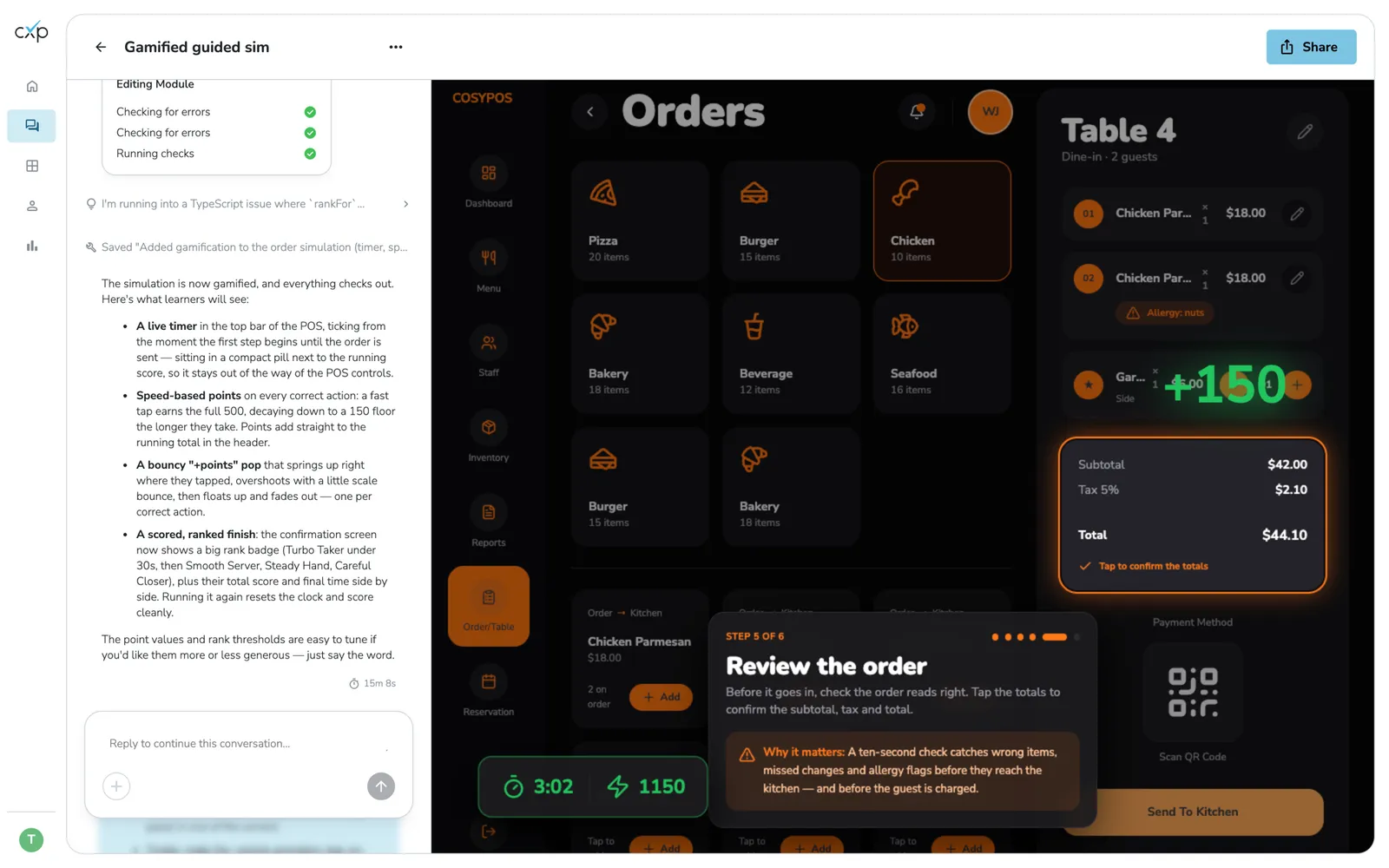
Gamified simulations are a personal favourite of ours so we had to check it worked.
-
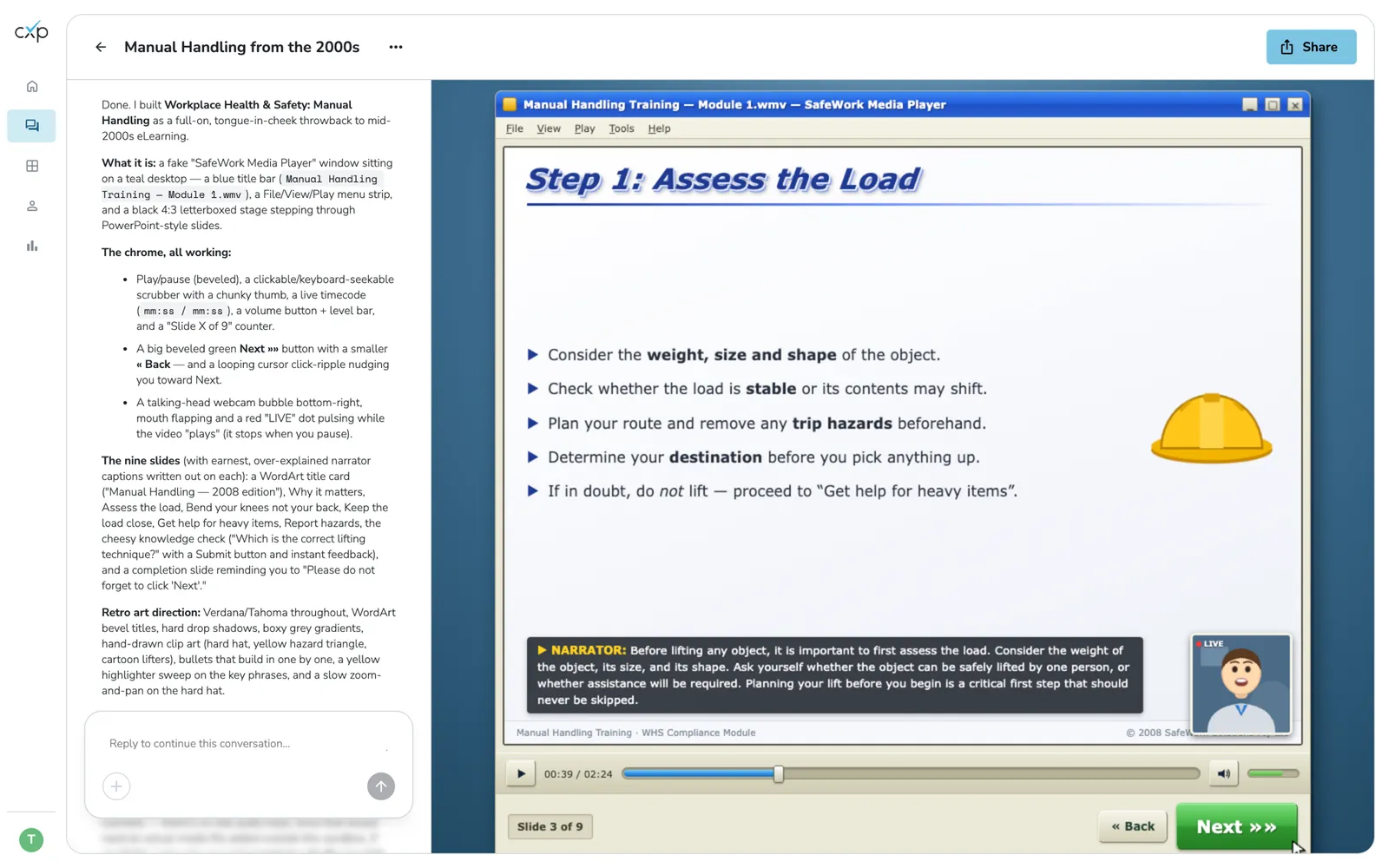
We won't stop you if you think this is peak eLearning. Clare does not judge.
The learning examples in this article aren’t overly inspired, but that’s because I’m not an instructional designer (although I’m working on developing that skill). I think you can do a lot better and I’m eager to see what you come up with.
We have limitless ideas on where to take this next. I’ve focused on instructional design but the title isn’t a misdirect, we really are rethinking everything about L&D. We’re applying this mindset to the entire lifecycle: take away the tedious gruntwork so L&D teams can thrive.
I want to see experimentation, let’s push the boundaries of what’s possible and make learning that inspires. No more embarrassment the next time someone mentions eLearning.
The ClearXP Design Agent is currently in private beta while we gather feedback, but we’re expanding weekly and you can apply for early access today.