
The “Netflix of Learning” isn’t what you think it is
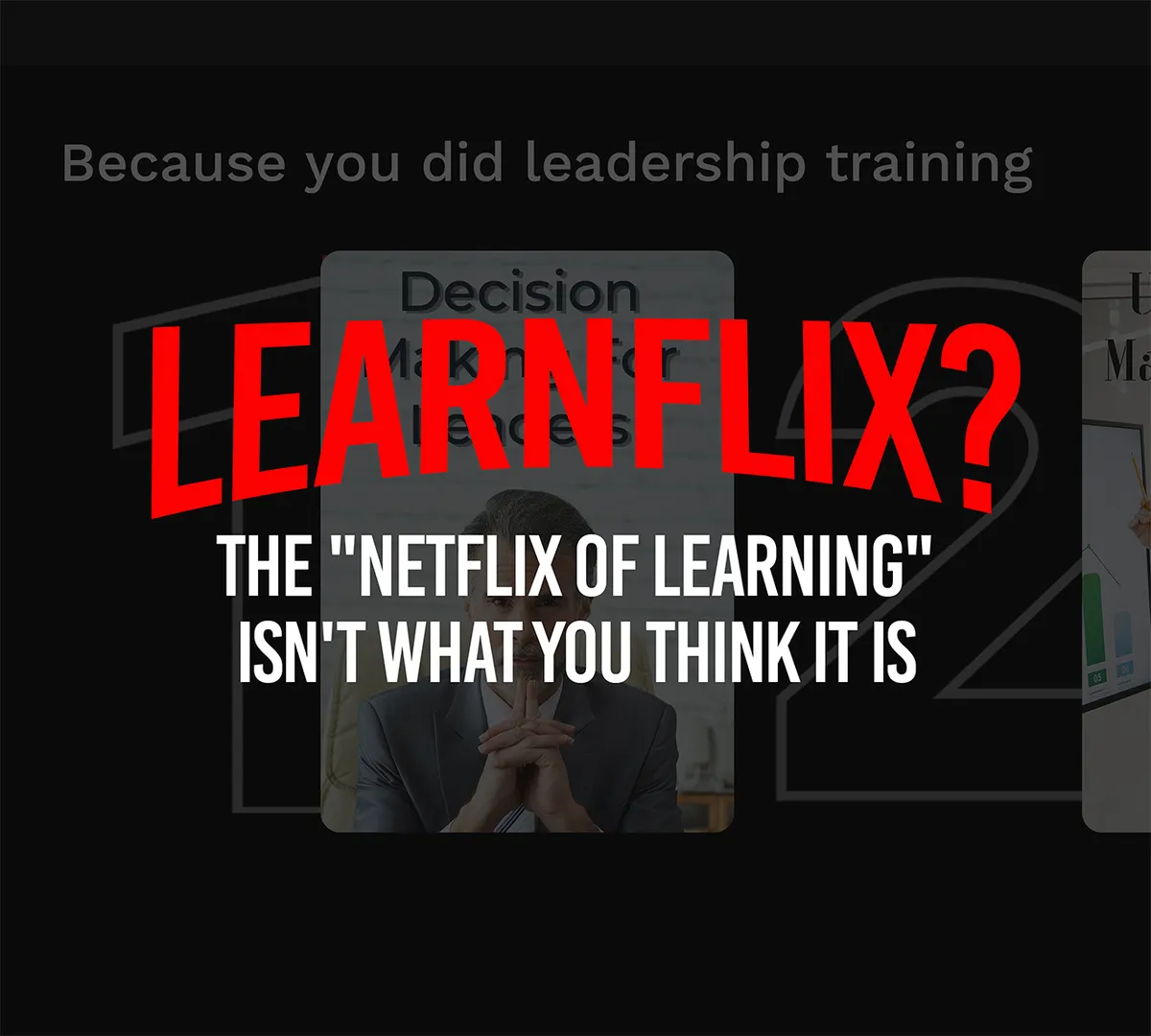
For years the learning industry has tried to mimic Netflix’s successful formula, but it’s the recent advancements in AI that’s going to enable that same level of impact.
Many years ago, when Netflix was approaching peak growth and turning heads in the tech industry, we had multiple customers ask us to create the “Netflix of Learning“. None of them could clearly articulate what that meant, they only knew how Netflix made them feel and wished to recreate that for their learners.
Just because it looks like Netflix, doesn’t mean you get the “Netflix effect”.
Inevitably this ended in visual recreations of Netflix’s tiled interface with the focus centred around catalog search and recommended content. Netflix’s user interface felt fresh and easy to use, interesting film and TV titles jumped out at you when you hit the home page. It didn’t matter that learning modules don’t offer the same appeal as blockbuster releases.
Organisations wanted their employees to engage with learning content in the same way they engaged with media at home, but just because it looks like Netflix, doesn’t mean you get the Netflix effect.
We all understood that Netflix represented a seismic shift in the film and television industry. This was something new and different, but putting aside the pretty interface, let’s consider what really made the streaming giant so disruptive:
- They had a gigantic library of content available to all users instead of individual product purchases.
- They let users consume content on-demand when they wanted, at the rate they wanted.
- They had a very effective recommendation engine that told you what to watch next.
Eventually the learning industry recognised these points and adapted them for organisational learning which was met with greater success than simply copying the pretty interface.
Enter the Learning Experience Platform
Whether intentionally riffing on the Netflix concept or not, Learning Experience Platforms (LXPs) were the closest we got to replicating that success. Key features of the LXP included a large content library backed by multiple content aggregators, a user-friendly interface and usually a recommendation engine. LXPs moved a layer deeper and offered the core concepts that made Netflix so appealing, but unfortunately they didn’t adapt it to their audience.
These weren’t bad features to offer, but they didn’t make sense in the context of organisational learning. There’s a fundamental difference between someone looking to Netflix and chill and an overworked employee needing to up-skill. For starters:
- Employees don’t consume learning like they consume media. They’re not idly browsing for something to occupy their time, they’re looking for something very specific.
- More importantly, they have mandatory learning requirements and a catalog-style screen undermines the urgency and importance of that training.
Film and television isn’t analogous to organisational learning so recreating Netflix within the context of a learning platform quite simply doesn’t work. But what if we were to take these principles and achieve the same outcomes in a way that makes sense for time-poor employees? It turns out AI provides the answer we’ve been looking for.
Large Language Models are the real Netflix of Learning
Large Language Models (LLMs) are finding mass adoption across a wide range of industries and L&D is no exception. We won’t sell the many benefits of LLMs for learning right now, but allow us to draw the not so obvious link between their capabilities and what LXPs tried to achieve years ago.
Let’s think back to Netflix’s point of difference:
- Giant Content Library: Modern LLMs are trained on petabytes of public information, this is far more than a LXP content aggregator could pull together.
- On-Demand Access: You simply ask the LLM a question and within seconds it responds with the relevant information.
- Recommendations: LLMs are able to assess a learner’s strengths and weaknesses and offer personalised recommendations or information that fills skill gaps.
Most importantly, they do this in a way that best suits a time-poor employee that needs access to relevant information as quickly as possible.
There is one aspect of LLMs that falls down in comparison to Netflix. The chatbot input box doesn’t quite capture the same sense of wonder as the visually immersive Netflix interface. We believe this is the final hurdle before we have a truly disruptive learning platform.
If someone out there is able to harness the power of LLMs and feed it through an unobtrusive user interface that provides information just-in-time, without the learner needing to explicitly ask for it, then they will be onto something truly special. And we look forward to using it.